🎯
What Does an Aircraft Dispatcher Actually Do?
Think of the aircraft dispatcher as the co-pilot on the ground. Under FAA regulations in the USA — and equivalent frameworks in EASA countries — a dispatcher shares legal responsibility with the aircraft captain for the safety of every flight they release. That's not a supporting role. That's a mission-critical one.
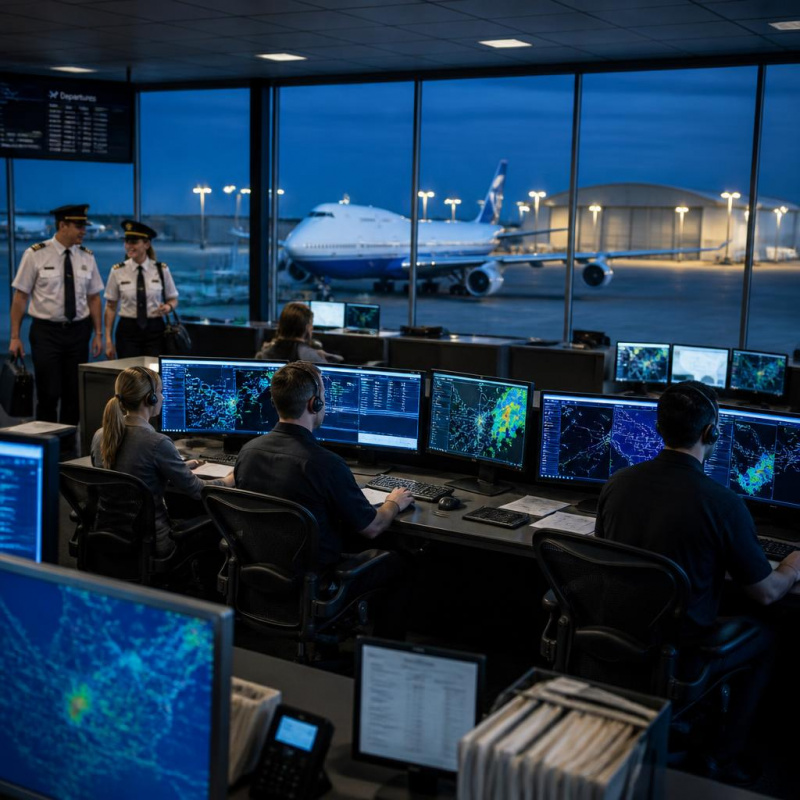
Before any commercial flight departs, the dispatcher has already done hours of invisible work: filing the flight plan, calculating fuel loads, analysing weather patterns along the route, checking NOTAM alerts, reviewing aircraft status, and coordinating with air traffic control. Once the flight is airborne, the dispatcher continues to monitor its progress in real time from the operations control centre.
Core daily responsibilities
- Create and file flight plans in compliance with aviation regulations (FAA/EASA)
- Analyse weather data, SIGMETs, AIRMETs and route conditions for every flight release
- Calculate fuel requirements — minimum, contingency, alternate and reserve
- Coordinate with captains and first officers pre-departure via ACARS or direct comms
- Monitor active flights in real time and issue re-routes when conditions change
- Coordinate with ground ops, maintenance, and ATC for off-schedule situations
- Manage AOG (Aircraft on Ground) situations and diversion planning
- Maintain operational control documentation and regulatory compliance records
The role is fast-paced, intellectually demanding, and carries genuine weight. Unlike many aviation support roles, dispatchers are not peripheral — they are embedded in the command structure of every flight they handle.
Dispatcher vs. Pilot: Which Career Is Right for You?
This is the question career-changers and aviation students search for most — and the honest answer is: it depends entirely on your priorities. Here's a clear side-by-side comparison.
| Factor | Aircraft Dispatcher | Commercial Pilot |
|---|---|---|
| Entry cost | ~$5,000–$10,000 (certification) | $80,000–$150,000+ (flight training) |
| Time to first job | 6–12 months | 3–7 years (ATP route) |
| Medical requirements | Basic 3rd class (less restrictive) | 1st class medical (strict) |
| Job security | Very high — FAA licence mandatory, limits outsourcing | High, but competitive entry |
| Automation risk | Low — judgement & legal responsibility cannot be automated | Low-medium long term |
| Work schedule | Shift-based, home every day | Extensive time away from home |
| Starting salary (USA) | $45,000–$65,000 | $50,000–$90,000 (regional) |
| Senior salary ceiling | $90,000–$130,000 | $200,000–$350,000+ (major airlines) |
| Lifestyle | Stable schedule, home base | Frequent travel, layovers, irregular hours |
How to Become an Aircraft Dispatcher: Step-by-Step
The path to becoming a certified aircraft dispatcher is one of the most accessible in professional aviation. You do not need flight hours, a degree in aeronautical science, or years of runway experience. Here's the process:
Choose an FAA-Approved Dispatcher School
Enrol in a Part 65-approved aircraft dispatcher course. Programmes typically run 5–6 weeks full-time or 3–4 months part-time. Look for schools with active airline placement partnerships. Check the FAA CATS database for approved providers.
Complete the Required Training Hours
FAA regulations require a minimum of 200 hours of instruction covering meteorology, flight planning, navigation, aircraft systems, federal aviation regulations, and emergency procedures. Your school curriculum is built around these requirements.
Pass the FAA Knowledge Test
The Aircraft Dispatcher Airman Knowledge Test (AKT) consists of 80 multiple-choice questions. A score of 70% or higher is required to pass. Most students achieve this after completing their course curriculum. Study resources include the FAA Aircraft Dispatcher Airman Certification Standards (ACS).
Complete the Oral & Practical Exam
An FAA Designated Pilot Examiner (DPE) — who is also certified as a dispatcher examiner — will conduct a comprehensive oral exam and practical demonstration. The oral exam typically lasts 3–4 hours and covers all core competency areas.
Receive Your Certificate & Apply
Once issued, your FAA Aircraft Dispatcher Certificate has no expiration date. Begin applying at regional airlines (Part 135 and Part 121 operators). Many dispatchers start with regional carriers and progress to major airlines after gaining operational experience.
EASA / European Certification
In Europe, the equivalent role is the Flight Operations Officer (FOO) or Operational Control Officer. While EASA does not mandate a unified dispatcher certificate equivalent to the FAA ADC, individual airlines and national aviation authorities (LBA in Germany, CAA in the UK, DGAC in France) have their own certification requirements. European candidates should research airline-specific training programmes, as many major European carriers run internal dispatcher academies.
Aircraft Dispatcher Salary: What to Expect at Every Level
Salary ranges vary significantly by employer type, country, and whether you are covered by a collective bargaining agreement. US major airline dispatchers covered by union agreements (TWU, IBT) typically receive the highest compensation packages, along with comprehensive benefits including non-rev flight privileges, pension contributions, and healthcare.
Additional compensation elements at major carriers
- Non-revenue travel benefits for dispatcher and immediate family
- Shift differentials for overnight and weekend work (typically 10–15%)
- Profit-sharing programmes at many US major carriers
- 401(k) or pension contributions (often 8–12% employer match)
- Full healthcare, dental and vision coverage
- Uniform / professional development allowances
Job Outlook 2025–2028: Why Now Is the Best Time to Enter
The aircraft dispatcher job market in 2026 is one of the most favourable in decades — and multiple structural forces are driving this:
1. Mandatory regulatory staffing
Under FAA regulations, airlines operating Part 121 domestic and international flights must maintain a specific ratio of licensed dispatchers to active flights. There is no legal workaround. Every flight that takes off requires a certified dispatcher to have released it. Fleet expansion directly translates to dispatcher demand — always, without exception.
2. Massive retirements in progress
A significant cohort of senior dispatchers who entered the field during aviation's expansion in the 1990s and early 2000s are now at or approaching retirement age. The replacement pipeline has lagged behind the retirement wave, creating acute shortages at several major US and European carriers.
3. Fleet growth continues globally
Global aviation passenger traffic is forecast to double over the next 20 years. Airlines are taking delivery of new aircraft — Airbus A320neo family, Boeing 737 MAX, A350, and 787 — at an accelerating pace. Every new aircraft added to a certificate holder's fleet requires corresponding increases in operational control staffing.
4. Automation is not a threat
Unlike many logistics and operations roles, aircraft dispatcher positions are structurally resistant to automation. The FAA's co-authority requirement — placing legal responsibility jointly on the captain and dispatcher — means human judgement and legal accountability are mandated by regulation. Tools improve efficiency; they cannot replace the role.
Ready to Find Your Aircraft Dispatcher Job?
Browse current dispatcher openings at airlines, MRO operators, and cargo carriers on Aviation-Job.com — updated daily with positions worldwide.
Browse Dispatcher Jobs →